2020/11/05

EGU 2021 "vEGU21" session "NH6.1 Remotely Piloted Aircrafts Systems (RPAS) for Natural Hazard Characterization and Risk Assessment" / 欧州地球科学連合2021セッション「自然災害評価とリスクアセスメントのための無人航空機の活用」発表募集

例年、ウィーンで開催されるEGU(欧州地球科学連合)は、来年2021年は完全オンラインで行われることとなりました。4月19〜30日の期間です。この"vEGU21"でも、無人航空機と自然災害のセッションを例年通り開催いたします。オンラインのため全世界から参加しやすくなっており、欧州に限らず、日本を含むアジア、オセアニア、またその他の地域にお住まいの皆様からも、多くの発表をお待ちしております。

なお、今年の2020年EGUもすべてオンラインでの開催となりましたが、その際も当セッションは活況で、チャットに加えてリアルタイムビデオミーティングも行い、有益な議論を交わすことができました。


We would like to invite you to contribute to the following 2021 EGU (vEGU21) SESSION:

NH6.1 - Remotely Piloted Aircrafts Systems (RPAS) for Natural Hazard Characterization and Risk Assessment

Convener: Daniele Giordan
Co-Convener: Marc Adams, Yuichi S. Ayakawa, Francesco Nex, Fabio Remondino

SESSION DESCRIPTION
https://meetingorganizer.copernicus.org/EGU21/session/39031

The use of Remotely Piloted Aircraft Systems (also called UAS) for natural hazard characterization and hazard assessment has sharply increased in the last years. Nowadays, the massive diffusion of mini- and micro-RPAS is becoming a valuable alternative to the traditional monitoring and surveying techniques, opening novel and exciting viewpoints. The advantages of the use of RPAS are particularly crucial in areas characterized by hazardous natural processes, where the acquisition of high resolution remotely sensed data could be a powerful instrument to quickly assess the damages and plan effective rescues without any risk for operators.

In general, the primary goal of these systems is the collection of different data (e.g., images, LiDAR point clouds, gas or radioactivity concentrations) and the delivery of various products (e.g., 3D models, hazard maps, high-resolution orthoimages).

The use of RPAS has promising perspectives not only for natural hazards, but also in other fields of geosciences, to support a high-resolution geological or geomorphological mapping, or to study the evolution of active processes. The high repeatability of RPAS flights and their limited costs allows the multi-temporal analysis of a studied area. However, methodologies, best practices, advantages and limitations of this kind of applications are yet unclear and/or poorly shared by the scientific community.

This session aims at exploring the open research issues and possible applications of RPAS in particular for natural hazard but also for geosciences in general, collecting experiences, case studies, and results, as well as defining methodologies and best practices for their practical use. The session will concern the contributions aiming at i) introducing new methods for using RPAS in natural hazard scenarios, including autonomous flights ii) describing the development of new onboard sensors and fusion methodologies for the acquisition data with RPAS, iii) reporting new data processing methods, e.g. based on machine learning, for image or point cloud segmentation and classification, and iv) presenting original case studies that can be considered an excellent example for the scientific community.


Please, pass this information to anyone who might be interested and feel free to contact us if you need any help or support.

Looking forward to meeting you virtually!

Warmest Regards

Daniele Giordan, Marc Adams, Yuichi S. Hayakawa, Francesco Nex, Fabio Remondino


THE DEADLINE FOR ABSTRACT SUBMISSION IS: 
13 JANUARY 2021 at 13:00 CET


INSTRUCTIONS FOR ABSTRACT SUBMISSION
https://www.egu21.eu/abstracts_and_programme/how_to_submit_an_abstract.html

An Abstract processing charge of €40 gross must be paid for each abstract submission. For late abstracts a higher APC of €80 gross will be invoiced.

All first authors of abstracts submitted to the General Assembly 2021 have to be 2021 EGU members. The membership can be acquired upon abstract submission.

Guidelines for abstract submission can be found at:

 
Additional information

Please note that participation to vEGU21 will be allowed after the payment of a registration fee.

The registration fees are waived for (a) scientists receiving an EGU award or medal, (b) scientists with a permanent affiliation in a low- or lower-middle income country according to the World Bank definition, (c) PhD candidates from all middle income countries according to the World Bank definition, (d) 2021 EGU emeritus members, and (e) undergraduate or master students.

Full information about the EGU2021: https://egu21.eu/about/general_information.html


2020/10/30

開催報告:横浜市立千秀小学校出張講義2020「UAV(ドローン)を使った環境計測~火山、海岸、里山、川~」開催報告

2020年10月26日(月)、本プロジェクトの早川が、横浜市立千秀小学校6年生を対象に、ドローンを用いた環境調査について出張講義を行いました。この取り組みは今年で4年目になります。児童たちは、来月に修学旅行で日光へ行く予定です。今年は、華厳の滝についても詳しく話題提供しました。

田谷の里山の3Dプリントも活躍。


小学校校区を俯瞰してみる。

華厳の滝についての解説。修学旅行で見ておくべきポイントは…!?


田谷の洞窟保存実行委員会+横浜市立千秀小学校の小大連携プロジェクトでは、今年は田谷の洞窟の内部の浮彫レリーフを解説する「解説カード」をの制作を実施する予定です。児童にデザインしたカードをデザインしてもらい、田谷の洞窟に来た拝観者が、このカードを持って歩きながら洞窟内の詳しい解説を知る事が出来るようになるような仕組みになるよう、準備を進めています。詳しくは、田谷の洞窟保存実行委員会のホームページをご覧ください。

2020/08/10

新着論文:中央アジアにおけるUAVとPPK-GNSSを用いた遺跡のマッピング

IOP Conference Series: Earth and Environmental Scienceに、本プロジェクトの早川と小倉が連名の論文が採択されました。中央アジア・ウズベキスタンにある考古遺跡をUAV-SfMおよび低価格GNSSを用いて計測したものです。オープンアクセスですので、どなたでも本文をご覧いただけます。

Suab, A.S., Hayakawa, Y.S., Kume, S., Yamaguchi, Y., Amanbaeva B., Kadyrov, A., Avtar, R., Ogura, T.(2020.08)Mapping of Archaeological Sites using UAV Aerial Survey and PPK GNSS Ground Survey Techniques in Central Asia, IOP Conf. Series: Earth and Environmental Science 540, 012014, DOI:10.1088/1755-1315/540/1/012014


2020/07/17

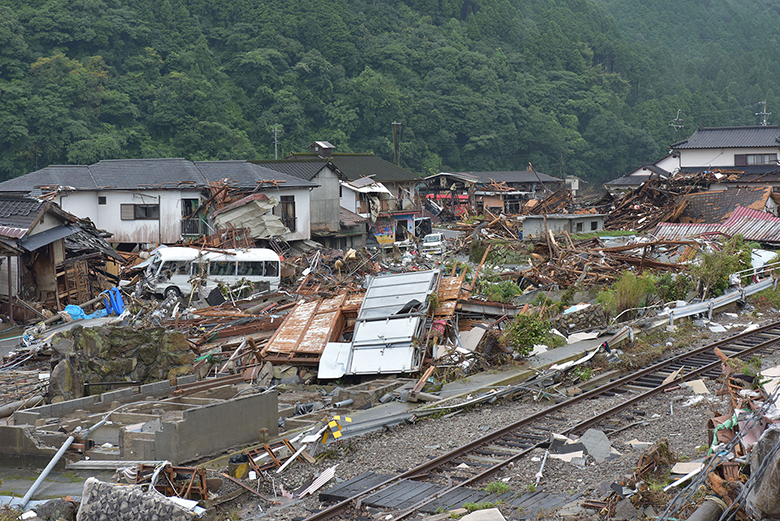
調査速報:令和2年7月豪雨による熊本県人吉市および球磨村渡地区の洪水被害の特徴

 本プロジェクトの内山さんが、令和2年7月豪雨による熊本県人吉市および球磨村渡地区の洪水被害状況について調査を実施し、速報を公開しました。以下のURL(防災科研HP)から本文を閲覧できます。


○要旨
 熊本県人吉市および球磨村は、同県南部を西流する球磨川流域の人吉盆地に位置する。この地域の上流側にある6つのアメダス観測点では、2020年7月3日から4日までの48時間で、418.5mmから497mmの雨量が記録された。これは、人吉市総合防災マップ(2017)の浸水想定における雨量(48時間で440mm)と同規模であった。7月3日明け方から降り始めた雨は、7月4日午前0時ころより急激に降水量が増加し、以降、10分間降水量で10mmを超える豪雨が、三度、断続的に発生した。この結果、24時間雨量では50年確率降水量(気象庁HP)を超過し、かつ、球磨川では、既往最大水位(2015年6月6日、4.16m)を超過した。人吉市では7月4日午前5時15分に避難指示が発令されたものの、球磨川やその支流で氾濫が生じ、氾濫流による建物・橋梁の破壊・流失、および浸水による被害が生じた。また、19名の死亡が確認された(7月11日時点)。

 現地調査は7月9日に実施し、被害の様相および浸水深を写真で記録し(以降、実績浸水深とよぶ)、既存の洪水ハザードマップ(人吉市、2017)で示された想定浸水範囲および想定浸水深との対比を行った。この結果、浸水範囲・浸水ともにハザードマップと調和的であったものの、想定浸水範囲は少し外側に広がり、また、想定浸水深が浅いところで実績浸水深が超過する傾向がみられた。このほか、細い水路の周辺で、局地的に高い浸水被害が生じた。また、人的被害は浸水深の深い地区に偏在している可能性が示唆された。

 これらの結果から、洪水ハザードマップは、実際の浸水被害を比較的正確に予測していると考えられる。このことは、洪水対策、避難計画、災害対応における洪水ハザードマップの有効性を示唆している。一方で、既存のハザードマップから、氾濫流による破壊的な被害が生じうること、およびその発生場所を読み取ることはできなかった。局地的な想定浸水深の大幅超過が生じた原因と合わせて、今後の詳細な検討が求められる。
なお、本報告は速報のため、今後の調査・解析により内容を修正することがある。


2020/07/05

JpGU-AGU Joint Meeting 2020 地形鮮明化プロジェクト 発表リスト

2020年7月12日(日)~16日(木)、JpGU-AGU Joint Meeting 2020がオンラインで開催されます。地形鮮明化プロジェクト関連発表をまとめました。それぞれの発表タイトルから予稿をご覧いただけます。また、地形鮮明化プロジェクトでは、セッションM-TT47"HIGH-DEFINITION TOPOGRAPHY AND GEOPHYSICAL DATA IN THE ANTHROPOCENE"(人新世における高精細地形・地球物理データ解析)を主催しております(EGU, AGUとのJoint Session)。7月12日(日)9:00-9:45にDFS(Discussion Forum Session)が設定されております。


※リスト中の[EE]は英語セッション、[JJ]は日本語セッションです。

[H-TT19] 地理情報システムと地図・空間表現

2020/06/30

発表募集:AGU Fall Meeeting 2020 セッション「Student Experiences with Remote Learning and Research」

 2020年12月7日~11日にアメリカ・サンフランシスコで開催されるAGU Fall Meeting 2020にて、本プロジェクトの小倉が、教育セッションにてリモート環境下における院生・学生の学修経験に関するセッションを共同で提案をしております。
 博士院生やポスドクはもちろん、大学教員、研究員など、大学教育に携わる方から参加を広く募っています。研究室内での学習環境(指導教員ー学生,学生間)、研究室を超えたコミュニティ、院生が非常勤講師として学習機会を提供するケース、などさまざまなケースの事例を幅広く募集しています。

 今年はCOVID-19の影響もあり、日本からオンラインで参加可能です。参加費も安くなっています。また、AGU Fall Meetingでは原則発表は1人1件までに限定されていますが、教育セッションは例外としてさらに1件発表可能です。このセッションでの発表を2件目の発表としても選択していただけることを歓迎しております。

 〆切は2020年7月29日です。多数のご参加をお待ちしております。Abstractの提出はこちらから。

 Here is the call for abstracts for our session #105053, "Student Experiences with Remote Learning and Research". The abstract submission is opening and ending on July 29. The detail of session is below.


Title: Student Experiences with Remote Learning and Research
Session ID#: 105053
Primary Convener:
Vincent C H Tong, University College London, Arena Centre for Research-based Education, Department of Earth Sciences, London, United Kingdom
Conveners:  
Alicia Kathryn Petersen, University of Erlangen-Nuremberg, Erlangen, Germany
Takuro Ogura, The University of Tokyo, Tokyo, Japan
Shahab Karimifard, University of Nebraska Lincoln, Lincoln, NE, United States

Session Description:
Remote learning and research have become a widespread practice in many parts of the world since the beginning of the COVID-19 pandemic.  For many, this has fundamentally changed the experience of students as learners, researchers, and educators.  We here invite students, graduate teaching assistants, education researchers, and academics to present their reflective accounts, evaluation metrics, and research on the challenges, opportunities and effectiveness of student engagement in remote learning and/or remote research in Earth and space sciences, both before and after the start of the pandemic.

We welcome presentations exploring a wide range of topics, including i) inclusivity and accessibility issues, ii) socio-economic factors (e.g., financial hurdles to accessing technology or benefits of reduced costs for certain activities), iii) peer-to-peer teaching and group learning on remote platforms, iv) innovative pedagogies, v) graduate student involvement in remote research and teaching, and vi) remote engagement with research groups and learning communities.

Index Terms:
0820 Curriculum and laboratory design [EDUCATION]
0825 Teaching methods [EDUCATION]
0850 Geoscience education research [EDUCATION]
0855 Diversity [EDUCATION]


2020/06/20

出前授業(オンライン):フィールドミュージアム体験(アート&アーケオロジー&ジオグラフィー)

以前もお世話になった大阪インターナショナルスクールの生徒(小学1、2年生)を対象に、当プロジェクトの早川がオンラインで出張授業を行いました。

主テーマは「フィールドミュージアム体験」ということで、福島や長野の縄文遺跡からの実況中継を軸に、スライドを使っての考古と環境、地理、景観の解説といったお話が、数回にわたって行われました。

こどもたちは、Zoomの画面を通して遺跡の現場にヴァーチャルトリップし、どのような遺物(モノ)があって、どのように使われていたのかを見学します。また、アーチストによる復原画や、はたまたドローンによる空撮動画・3Dモデルをとおして、何千年も前にそこにいた人々の暮らしを想像してみます。クリやクルミなどの茂る村の周りとそこに潜む動物たち、また近くの川や海から獲れる貝や魚。それらをどうやって採ったのか?何をどのように使って調理したのか?人々はどのように着飾っていたのか?

家の中に居ながらにして、遠くの遺跡を感じることができる。現地からの遺跡や遺物の中継映像、かつての暮らしを再現する復原図像、さらに鳥目線からの3次元的な景観模型と、多様な素材を観察することから、こどもたちはさまざまに思いを巡らせました。

学校ででも、現場ででも、実際にモノを見て、触って学ぶ機会もあると良いですが、それだけでない、オンラインだからこそできることもあります。新しいつながりの試行も兼ねて、このインターナショナルでインターディシプリナリーな授業は執り行われました。